
01Beginnings
A difference almost too small to see
Today, galaxies crowd together in some parts of the universe and are scarce in others. The early universe was far smoother. Long before the first stars or dust appeared, some patches of matter were ever so slightly denser than their surroundings.
As the universe expanded, gravity drew a little more matter into those patches. The more they gathered, the harder they pulled. Over billions of years, those barely perceptible differences grew into the crowded places and sparse expanses we see today.
02Gravity
Gravity weaves a web
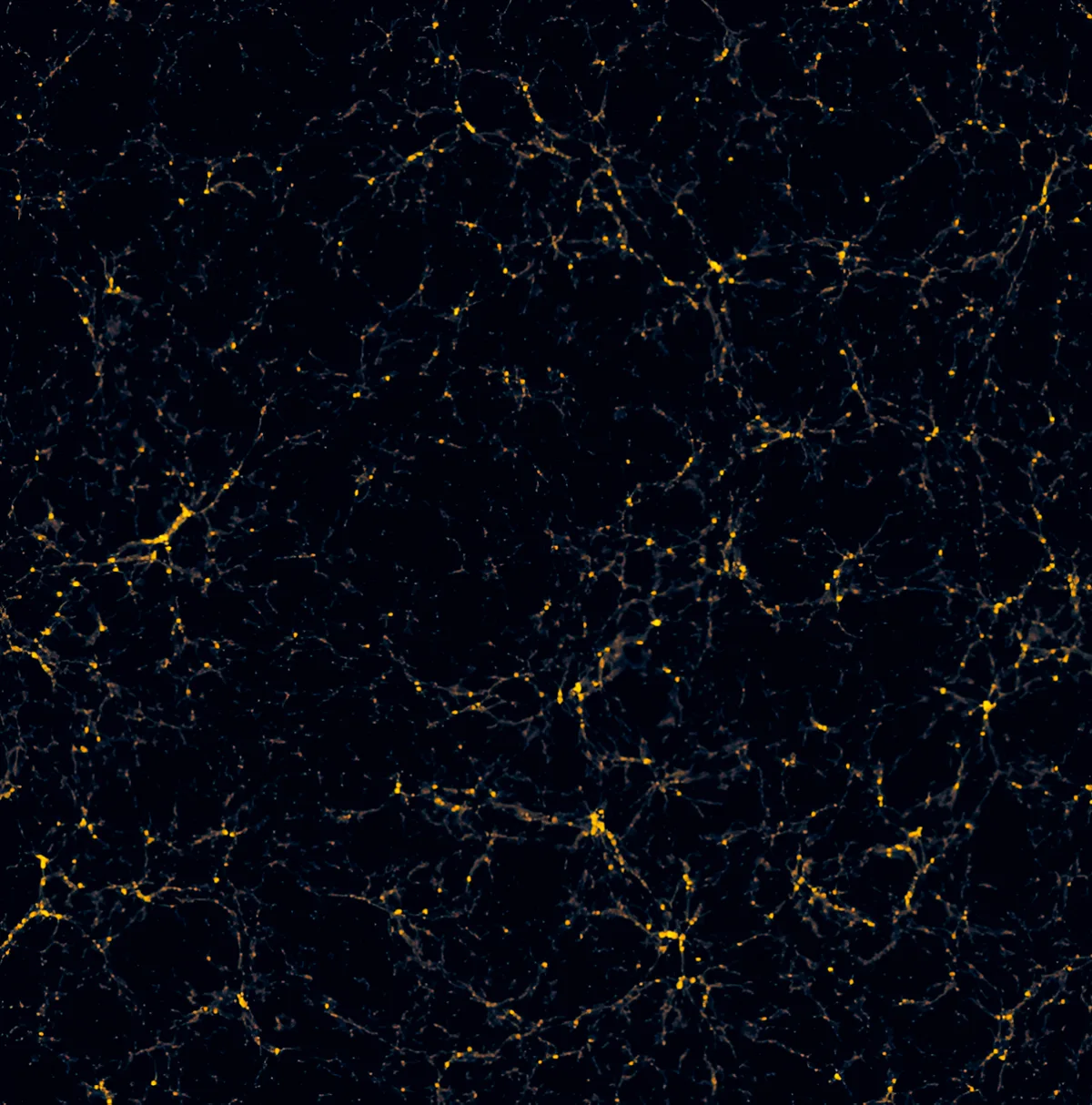
Gravity draws matter together unevenly. In some places, matter flattens into sheets and then gathers into slender filaments. Where the filaments meet, matter streams into knots, some of which grow into galaxy clusters. In between lie vast, sparsely populated voids.
Invisible dark matter makes up most of the web’s framework. Like rain collecting in valleys, gas gathers where dark matter has deepened the pull of gravity. In some places the gas cools, gathers, and forms stars. Galaxies light up along the web, tracing part of its outline.
03Stardust
The dust came later
The earliest stars formed from gas made almost entirely of hydrogen and helium. As stars evolved, reactions inside them made elements such as carbon and oxygen. Stellar winds and explosions carried some of those elements back into space. Some condensed into dust, which later helped make planets.
The carbon in our bodies was made deep inside stars. That ordinary element ties us to stars older than the Sun. The web was never destined to produce us. Long afterward, in one small part of it, there were oceans and life that could look back at the stars.
04Kinship
The ties we cannot see
Genesis pictures a beginning with darkness over the deep and the spirit of God moving over the waters. The Buddhist teaching of dependent arising draws attention to the conditions that bring things into being. Cosmology traces the history of matter through observation. Closer to home, how many of the ties that shape us go unnoticed?
A passing remark, a letter from far away, or a hand offered in a difficult moment can change the course of a life. Years later, the details of that moment may have faded, while the ripples it set in motion are still spreading.
Across the empty spaces, we can still bring one another light.